
An article from Boon Labs. We make the scalp serum described at the end of it. Everything here is written to be useful whether or not you buy anything, and nothing on this page is medical advice.
Perimenopause & hairYour doctor said your labs were fine. Your stylist said it was normal for your age. Both were right, and neither one helped.
It usually starts in a photograph. Not in the mirror — the mirror is forgiving, and you have been looking at yourself in it every day for forty-seven years. A photograph taken by somebody else, from slightly above, in bad overhead light. And there is your part, and it is wider than you remember it being.
Then you start noticing the other things, and they were all there before you had a word for them. The ponytail that takes an extra twist. The amount in the drain after a wash, which you have started, slightly guiltily, to estimate. The particular place you have begun choosing to stand in group pictures.
If you have been to your doctor about it, you were probably told your labs were fine. They probably were. If you mentioned it at the salon, you were probably told it is normal at your age. That is also true. Both answers are accurate and both of them leave you exactly where you started, which is holding a problem nobody has offered you a plan for.
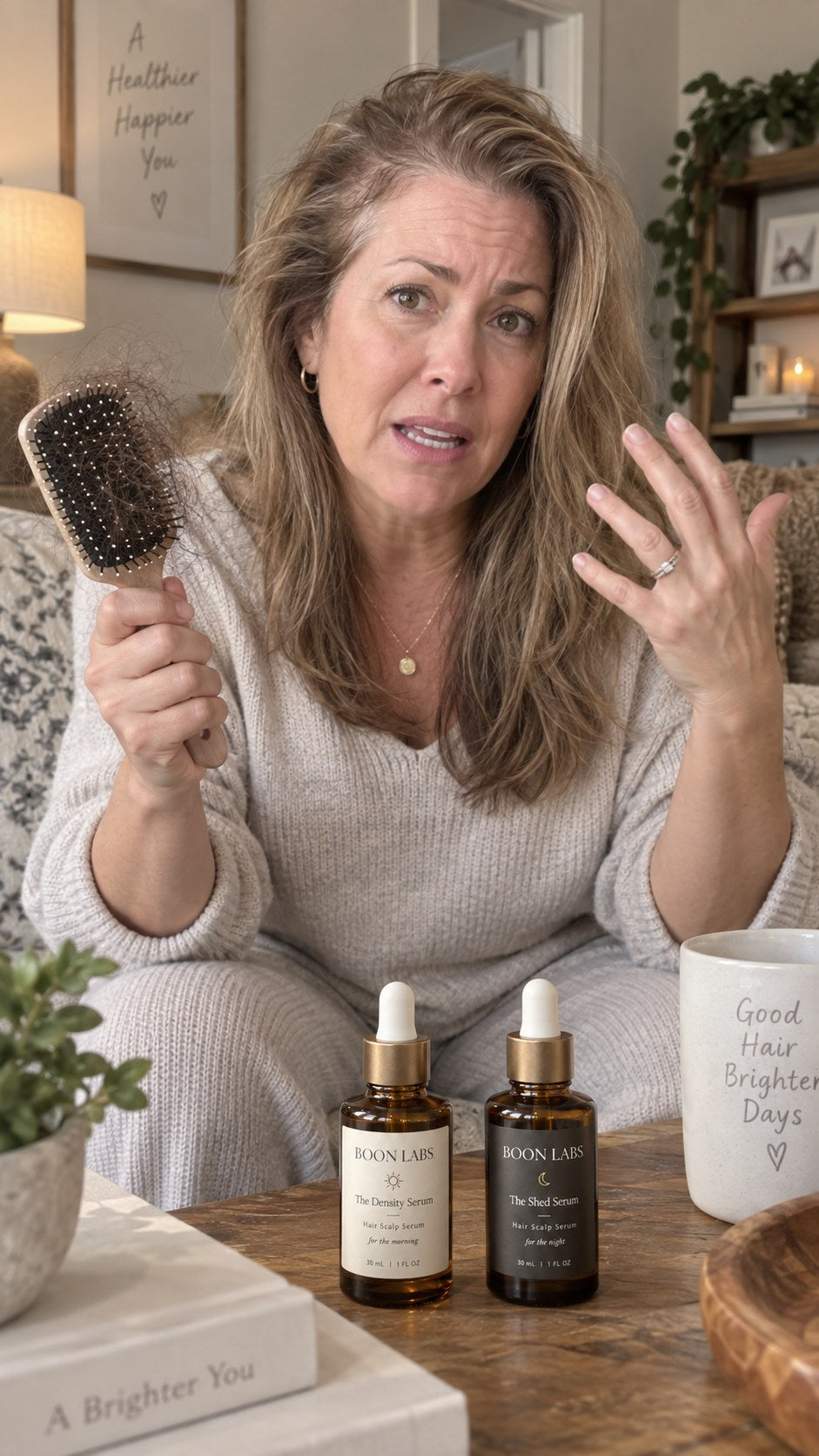
What is actually happening up there
A hair follicle does not grow continuously. It runs a cycle: a long growing phase that can last years, a short transition, a rest, and then the strand sheds and the follicle starts again. At any moment most of the follicles on your head are in the growing phase and a minority are resting. That ratio is what density is.
Estrogen is one of the signals that helps hold a follicle in the growing phase. As estrogen declines through perimenopause, that phase runs shorter. More follicles sit in rest at the same time, and the strands that grow back are finer and shorter than the ones they replaced.
You are not losing follicles. You are losing the length of time each one spends growing. That reads as density, and density reads first at the part.
This matters more than it sounds, because it explains why the shelf full of things you have already tried did nothing.
Why the last four things didn't work
Biotin and collagen. Supplements correct a deficiency. Biotin deficiency is genuinely rare in anyone eating normally, and if you did not have one, topping it up does not give you a surplus of hair. You were treating a nutrition problem you did not have.
Rosemary oil. It gets to the right place — the scalp — which already puts it ahead of a supplement. The practical problem for most women over forty with fine hair is that it is an oil, and by two in the afternoon your roots know it. A routine you abandon in week five is not a routine.
Expensive shampoo. Shampoo is on your scalp for about ninety seconds and is then deliberately rinsed off. It is a cleaning product. It is not a delivery system for anything.
Minoxidil. This one is different, and it deserves an honest paragraph rather than a dismissal. Minoxidil is a real over-the-counter drug with real published evidence behind it. Many women use it and are glad they did. The reasons women commonly give for not wanting it are also real: an initial shedding phase that is frightening if nobody warned you about it, scalp irritation for some people, and the fact that whatever it gives you it takes back if you stop, which makes it an indefinite commitment. It is a decision worth making with a doctor rather than with an advert — ours included.
What a scalp serum can and cannot do
Here is the part most brands skip, so we will do it first.
A cosmetic scalp serum is not a drug. It cannot claim to treat, cure or prevent hair loss, and any company telling you theirs regrows hair is either breaking the law or about to. What a well-made one can do is work on the skin your hair grows out of: hydrate it, calm it, and support the appearance of density over months rather than weeks.
Three separate outcomes get collapsed into one in almost every advert you will see: less shedding, a more comfortable scalp, and visible coverage. They are not the same thing, they arrive on different timelines, and a brand that promises all three in one sentence is telling you something it cannot know.
How to test anything on yourself, properly
This works whatever you end up buying, including nothing.
Photograph your part before you start. Same window, same time of day, hair dry and parted the same way, phone at the same distance. Do it again on day 30, day 60 and day 90. Human memory is a terrible instrument for slow change and a photograph is a good one.
Give it ninety days, and expect nothing at sixty. Scalp comfort tends to shift in the first week or two. Shedding is usually the next thing to change, and most women notice it in the brush before they notice it in the mirror. Anything visible at the part is months out, because hair grows at roughly half an inch a month and there is no version of this where that speeds up.
Judge it on an ordinary afternoon. Not on the morning you apply it. If it flattens your roots by lunchtime, it does not matter how good the ingredient list is — you will stop, and stopping is the only guaranteed way for it not to work.
Ask three questions before you buy anything. Does the claim say what was measured, on how many people, for how long? Does the price on the advert match the price on the receipt? And can you get your money back after enough time has passed to actually know?
On a GLP-1 medication as well? The shed from fast weight loss lands on top of all of this — we wrote a separate page for it.
The AM/PM System
Two serums written against hormonal thinning specifically. Density Serum every morning, Shed Serum at night while shedding is active. Clear and water-based rather than oils, so they do not flatten fine hair. Safe on grey and color-treated hair. One dropper at the part, two minutes, nothing to rinse off.
We put the window at ninety days rather than fourteen because fourteen days is not a fair test of anything that happens on a scalp, and because day sixty — the month where nothing new seems to be happening — is where most people quit. Use it every day for ninety days, finish the bottle if you want to, and if your scalp and hair do not look better to you, email us one line and we refund it. You do not ship anything back.
And if you decide to buy nothing at all, take the day-one photograph anyway. In three months you will be glad you have it.
Who this is not for.
Postpartum shedding, alopecia areata, thyroid-driven or medication-related hair loss, and anyone under 35. Those have different causes and this product was not built for them.
If your shedding came on suddenly, is patchy rather than diffuse, or arrived alongside other symptoms, see a doctor rather than a serum. Saying no to those cases is what makes the yes credible.
Empty bottle, full refund.Use it every day for 90 days. If your scalp and hair don't look better to you, email us one line and we refund it. Nothing to ship back, no form to fill in.