
An article from Boon Labs. We make the scalp serum described at the end of it. Everything here is written to be useful whether or not you buy anything, and nothing on this page is medical advice.
GLP-1 & hairThe jeans fit. The ponytail doesn't. What a GLP-1 does to your hair, and what to do about it.
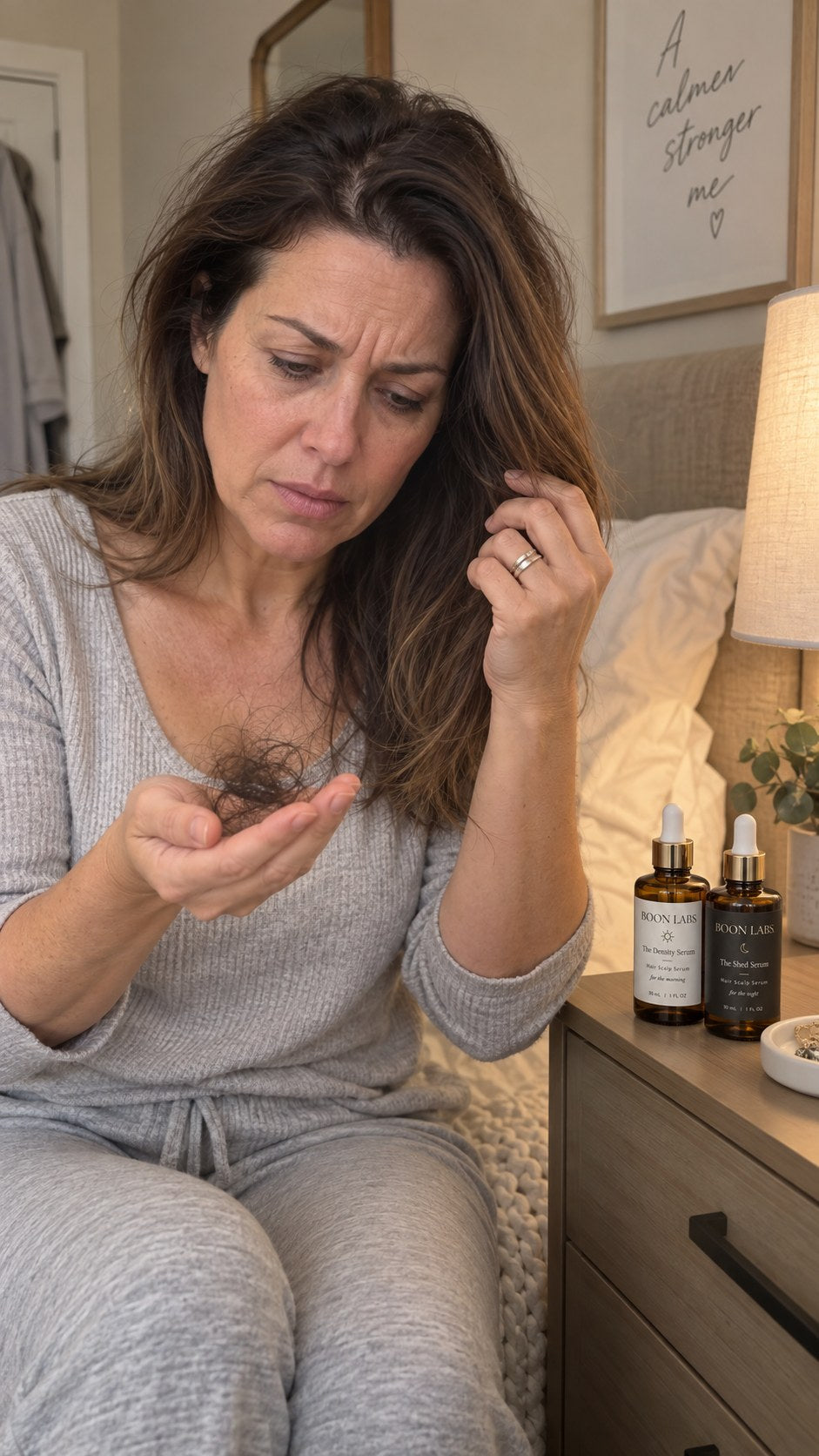
It arrives about three or four months in. The weight is coming off, your clothes are different, people have started saying something — and then one morning there is more hair in the drain than you have ever seen, and it keeps happening. The ponytail takes an extra twist. The part looks wider in the bathroom mirror, and worse in the photograph your daughter took.
If you are on Ozempic, Wegovy, Zepbound, Mounjaro or any of the others, and you are also somewhere in the change, this page is for you. It is written for the woman who is holding two things at once: a medication that is working, and hair that is not.
What is actually happening
A hair follicle runs a cycle: a long growing phase, a short transition, a rest, a shed, then it starts again. Normally the follicles on your head are out of step with each other, so the shedding is spread evenly across the year and you never notice it.
A sudden change to the body — an illness, surgery, a birth, or losing weight fast — pushes a large batch of follicles into rest at the same time. Two to four months later that batch sheds together. Your doctor may call it telogen effluvium. You will call it the drain.
The hair falling out now was decided months ago, when the weight loss began. What you do today shapes what grows back.
As far as anyone currently understands it, the loss is driven mostly by the speed of the weight loss and by eating far less than before — protein in particular — rather than by the drug acting on the follicle directly. The makers' own trial data lists hair loss as a reported side effect for a small share of people, and the reports are more common in the people who lose the most, fastest.
Why it lands harder in your forties and fifties
Here is the part that is specific to you. Through perimenopause, falling estrogen already shortens how long each follicle stays in its growing phase. More follicles sit in rest at the same time, and the strands that grow back are finer and shorter than the ones they replaced. That reads as density, and density reads first at the part.
A GLP-1 shed lands on top of that. So where a thirty-year-old sheds and then simply grows it back, you shed from a scalp that was already holding less, and the regrowth comes in finer. Two forces on the same follicles. That is why it feels dramatic, and it is also why it is worth doing something rather than waiting it out.
What usually happens next
Most of this kind of shedding settles once the weight stabilises — usually within a few months of the loss slowing down. Regrowth follows, and it is slow: hair grows at roughly half an inch a month, and the part is the last place it shows. The honest timeline is closer to a year than a season.
None of that is guaranteed, and it is not our place to promise it. It is the general shape of what happens.
Six things worth doing
1. Do not stop the medication because of your hair without talking to the prescriber. The hair is temporary for most people; the reasons you started the medication probably are not. Raise it at the next appointment. There may be a slower dose schedule.
2. Eat protein like it is a prescription. Hair is made of it, and it is the first thing that drops when appetite disappears. Ask the prescriber or a dietitian for an actual daily number and hit it before anything else on the plate.
3. Ask for the bloods. Ferritin (stored iron), thyroid, vitamin D and B12 are the usual suspects that make a shed worse, and heavy periods in perimenopause quietly drain iron. Low results are fixable. Guessing with supplements is not.
4. Slow it down if you can. The rate of loss matters more than the total. This is a conversation with your doctor, not a reason to eat less well.
5. Photograph the part today. Same window, same time of day, hair dry and parted the same way, phone at the same distance. Again at day 30, 60 and 90. Memory is a terrible instrument for slow change and a photograph is a good one. You will want the day-1 frame whatever you decide to do.
6. Look after the scalp you are growing from. This is the part we can help with, so we will be precise about what it does. A leave-in scalp serum cannot stop a shed that was decided months ago, and it cannot claim to treat or prevent hair loss — it is a cosmetic, not a drug. What a well-made one does is keep the skin your hair grows out of calm and hydrated, and support the appearance of density over the months the regrowth takes. On fine, weight-loss-thinned hair the finish matters: an oil will flatten it by lunchtime, and a routine you abandon does nothing.
The Density Serum — every morning, through the shed and after it.
A clear, water-based scalp serum written against hormonal thinning. One dropper at the part, thirty seconds of massage, nothing to rinse off, no film on fine hair. Safe on grey and color-treated hair. If the shedding is heavy, add the Shed Serum at night while it lasts, then drop back to the Density Serum alone when it settles.
Not sure where you are in the change? Take the 2-minute quiz — it now asks about GLP-1s.
We put the refund window at ninety days because that is how long a scalp routine honestly takes to judge, and because month two — when the shed is still going and nothing new seems to be happening — is where most people quit. Use it every day for ninety days. If your scalp and hair do not look better to you, email us one line and we refund it. You do not ship anything back.
And if you buy nothing at all: eat the protein, ask for the bloods, take the photograph. Those three will do more for you than any bottle.
When to see a doctor rather than a serum.
Shedding that is patchy rather than all over, that came on within weeks rather than months, or that arrived with other symptoms — fatigue, feeling cold, changes to your skin or nails. Those point to something else, and something else needs a doctor.
Boon Labs is a cosmetic product. It supports the appearance of density and scalp comfort. It does not treat, cure or prevent hair loss, and nothing on this page replaces the advice of the person who prescribes your medication.
Empty bottle, full refund.Use it every day for 90 days. If your scalp and hair don't look better to you, email us one line and we refund it. Nothing to ship back, no form to fill in.